French Birth Records From 1670 To 1830
French Birth Records From 1670 To 1830
French Birth Records From 1670 To 1830 France Online Genealogy Records • FamilySearch France Online Genealogy Records. These are genealogy links to France online databases and indexes that may include birth records, marriage records, death records, biographies, cemeteries, censuses, histories, immigration records, land records, military records, newspapers, obituaries, or probate records.
https://french-birth-records-from-1670-to-1830.govbackgroundchecks.com/
All Birth, Marriage & Death in the Card Catalog
Most records are in French, but some records may be in German or Latin. ... © 1997-2026 Ancestry; Corporate Information · Privacy · Terms ...
https://www.ancestry.com/search/collections/catalog/?category=34France Census
1836-1911 Belfort, Alsace, France, Censuses 1836-1911 at Ancestry - index & images($) ... © 2026 by Intellectual Reserve, Inc. All rights reserved ...
https://www.familysearch.org/en/wiki/France_CensusThe 300-year-old fertility statistics still in use today - BBC News
Most women over the age of 25 will be familiar with those concerned looks from older relatives followed up by a whispered: "Isn't it about time you started thinking of having a baby?" But what if much of what we have been led to believe about the impact of age on fertility is not true?
https://www.bbc.com/news/magazine-24128176
Your fertility, checked - Columbia Journalism Review
Sign up for the daily CJR newsletter. In 2002 Sylvia Ann Hewlett terrified career-oriented women when she hit them with a cold truth: Regardless of advances in medicine, it’s difficult for women to get pregnant beyond their early 30s. If women wanted to have children, her book Creating a Life urged, they better leave their desks and start planning.
https://www.cjr.org/the_observatory/atlantic_jean_twenge_fertility.php
When to have kids: A look at female fertility
Rarely mentioned is the source of the data: French birth records from 1670 to 1830. ... © 2026 Minnesota Public Radio. All rights reserved.
https://www.mprnews.org/story/2013/07/01/daily-circuit-female-fertility“How Long Can You Wait to Have a Baby?”: Jean Twenge - First Things
at The Atlantic: . . . As a psychology researcher who’d published articles in scientific journals, some covered in the popular press, I knew that many scientific findings differ significantly from what the public hears about them. Soon after my second wedding, I decided to go to the source: I scoured medical-research databases, and quickly learned that the statistics on women’s age and fertility—used by many to make decisions about...
https://firstthings.com/how-long-can-you-wait-to-have-a-baby-jean-twenge/
Is running out of time to have children a myth? - Bryan County News
Theres a popular myth that if youre a woman who wants to have children, your twenties are the right time to start. Get married anytime after your mid-twenties and youll find family members (or even complete strangers) who find it acceptable to tell you to 'get your skates on' and start trying soon before time runs out.
https://www.bryancountynews.com/lifestyle/trending/is-running-out-of-time-to-have-children-a-myth/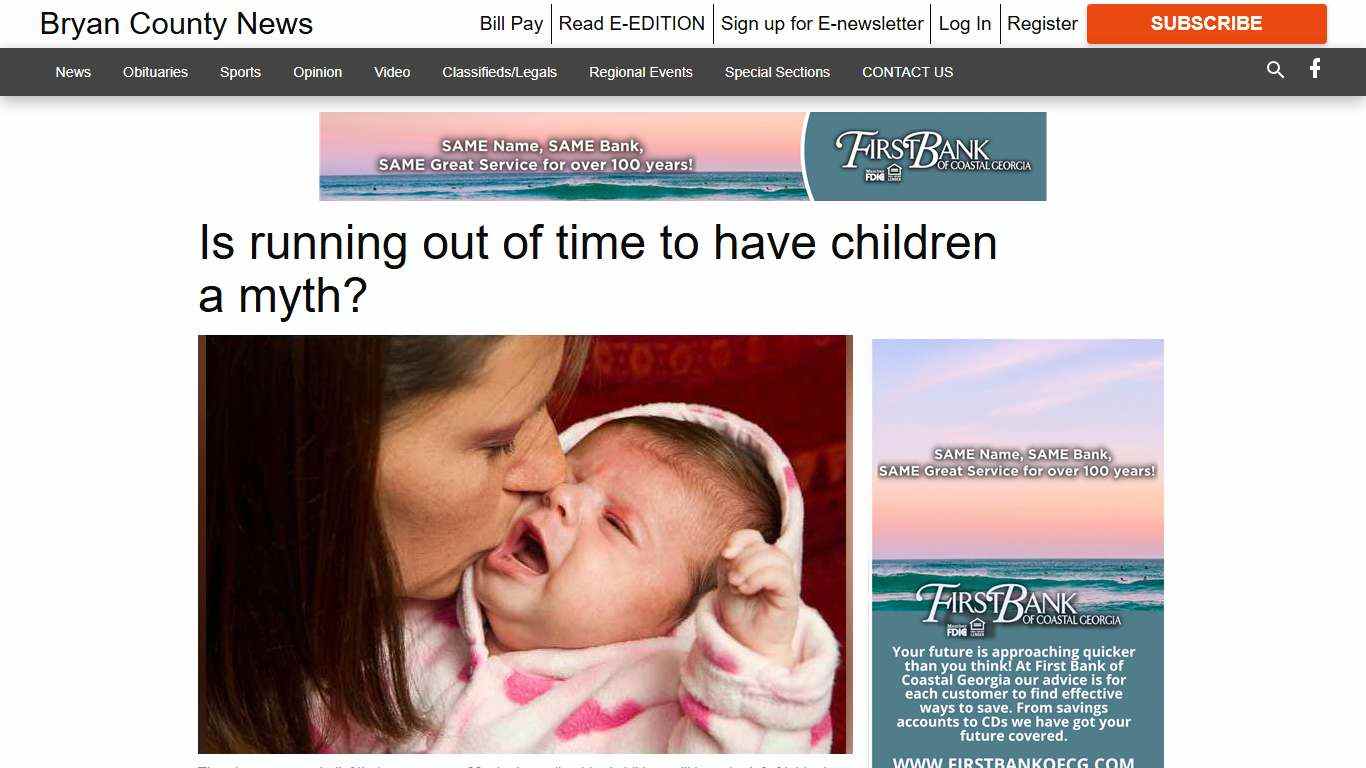
Is running out of time to have children a myth? - Effingham Herald
Theyre not trying to be rude, though thats often how theyll come across. Their comments come from the often repeatedbut not entirely accuratestatistics that suggest how fertility declines sharply each year after your twenties. If youre a woman in your thirties (or perhaps in your forties) and youve not yet been blessed with children, that doesnt necessarily mean youll remain childless.
https://www.effinghamherald.net/lifestyle/hot-topics/is-running-out-of-time-to-have-children-a-myth/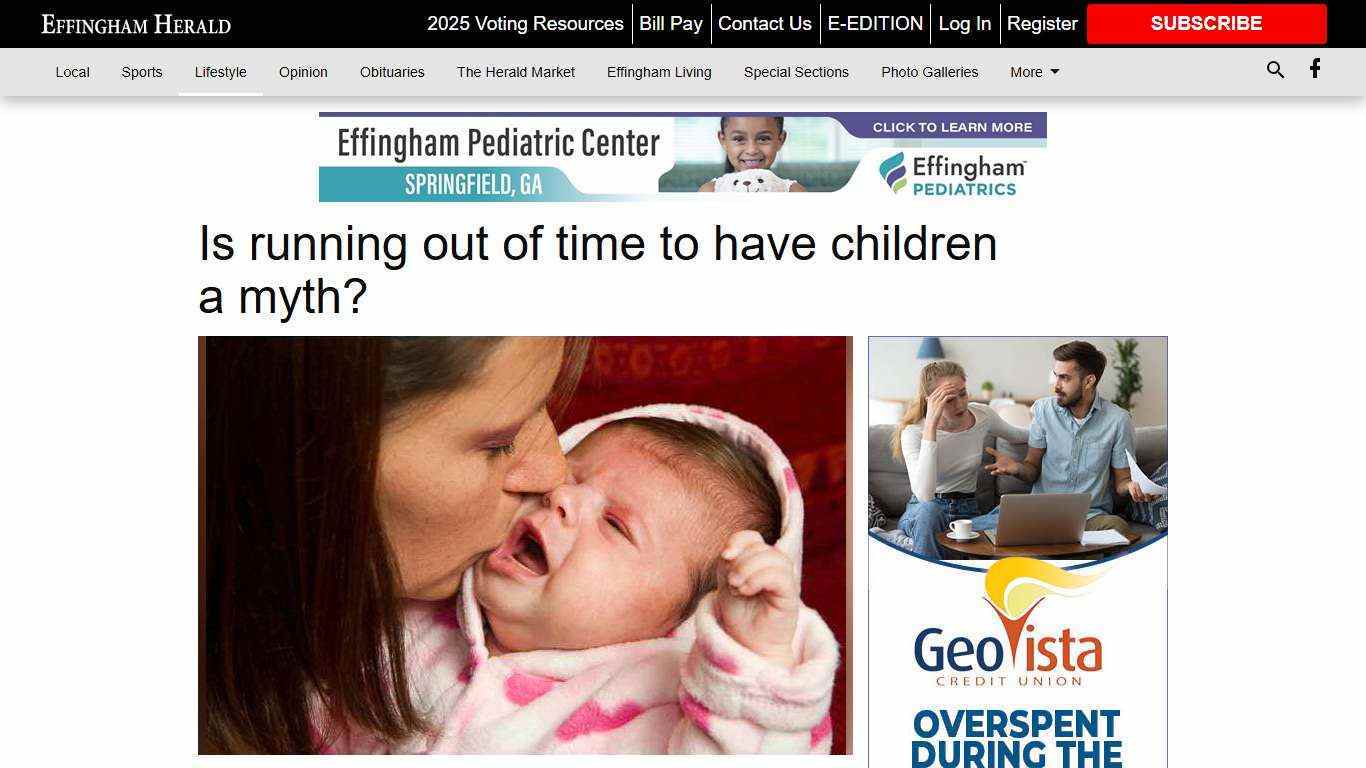
Fertility after 35: Everything you thought you knew was wrong, says new Atlantic article.
I often joke that working in women’s media for six years has made me way too aware about how one’s fertility declines with age. My husband and I decided to start trying to conceive when I was 29, in part, because I knew, from all of the articles I’d read on the job, that my eggs were rapidly shriveling up and dying with each passing day.
https://slate.com/human-interest/2013/06/fertility-after-35-everything-you-thought-you-knew-was-wrong-says-new-atlantic-article.html
How late is TOO late to have a baby? - Birthwell Birthright
I recently came across a very interesting article that appeared in The Atlantic. Written by American psychologist Jean M. Twenge, a professor of psychology at San Diego State University and the author of The Impatient Woman’s Guide to Getting Pregnant, the article aims to debunk the long-held myth that a woman’s fertility comes to a grinding halt once she hits about 35.
http://birthwellbirthright.com/late-late-baby/
Individual : PARIS PARISSE - Search all records - Geneanet
PARIS (PARISSE) Jean Baptiste Spouse : DUPAS Anne Marie (1767) Birth 1745 Fontaine-Notre-Dame, 59400, Nord, France Bourlon, 62860, Pas-de-Calais, France Family tree owner - 145,131 individuals - Last updated on December 22, 2025 PARIS PARISSE Marguerite Spouse : THIEBAUT Joseph (1824) Birth 1803 Death 1852 Le Clerjus, Vosges, France Family tree owner - 138,014 individuals - Last updated on January 14, 2026 PARIS PARISSE Marie Barbe Spouse : PE...
https://en.geneanet.org/fonds/individus/?categories_1__arbres__=arbres&categories_2__arbres%23utilisateur__=arbres%23utilisateur&go=1&nom=PARIS+PARISSE&page=3&size=50
Summit Series: A Shared Language for Working with Data - Citizen Evidence Lab
In data-informed investigations, storytelling is a way to organise and transmit information. However, stories are selective by design. At the end of an investigation, a dataset is able to tell, and therefore amplify, some stories and not others. Even a well-written methodology is a partial story of the decisions made during the investigation: why certain things, events or people are reproduced in the dataset, and others not.
https://citizenevidence.org/2023/03/30/language-for-data/
Study: ICSI In Vitro Fertilization May Cause Autism | The New Republic
There’s been a lot of chatter these past few weeks about an Atlantic article by Jean Twenge called “How Long Can You Wait to Have a Baby?” In it she debunks some of the research underlying the claim that women’s fertility declines steeply after 35.
https://newrepublic.com/article/113765/study-icsi-vitro-fertilization-may-cause-autism